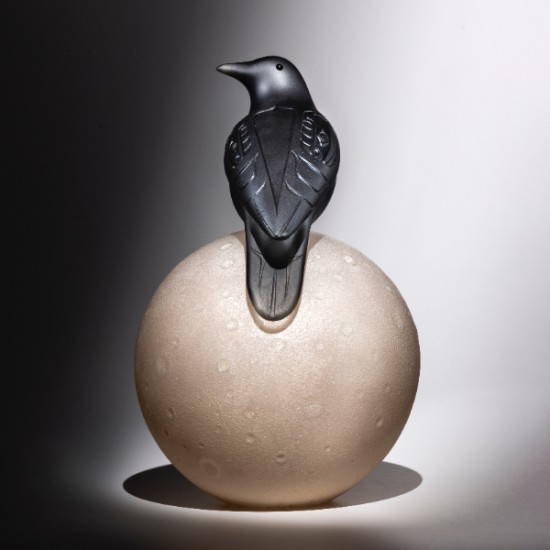
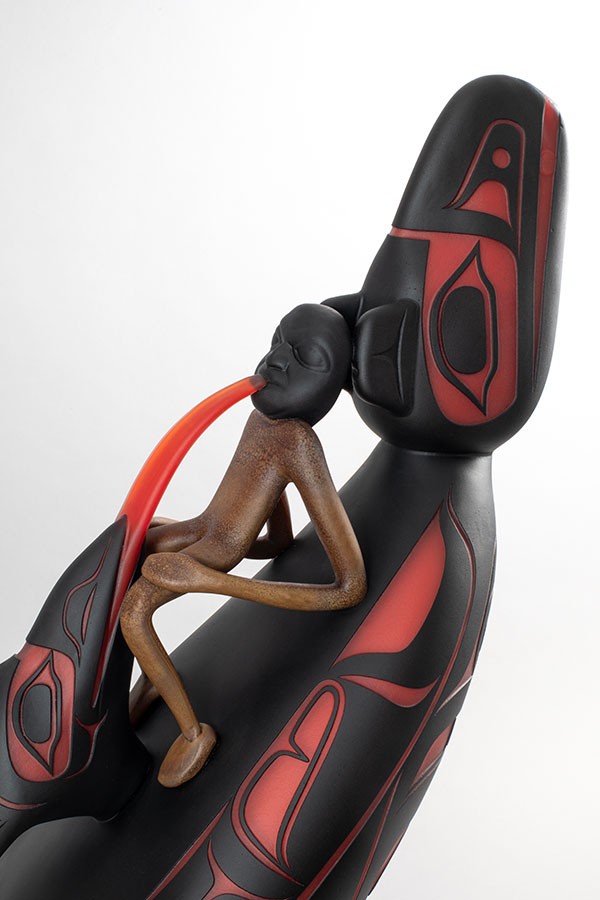
Preston Singletary
Speaking in Tongues
Blown and sand-carved glass, 26"h x 8"w x 13"d, Item No. 24000,
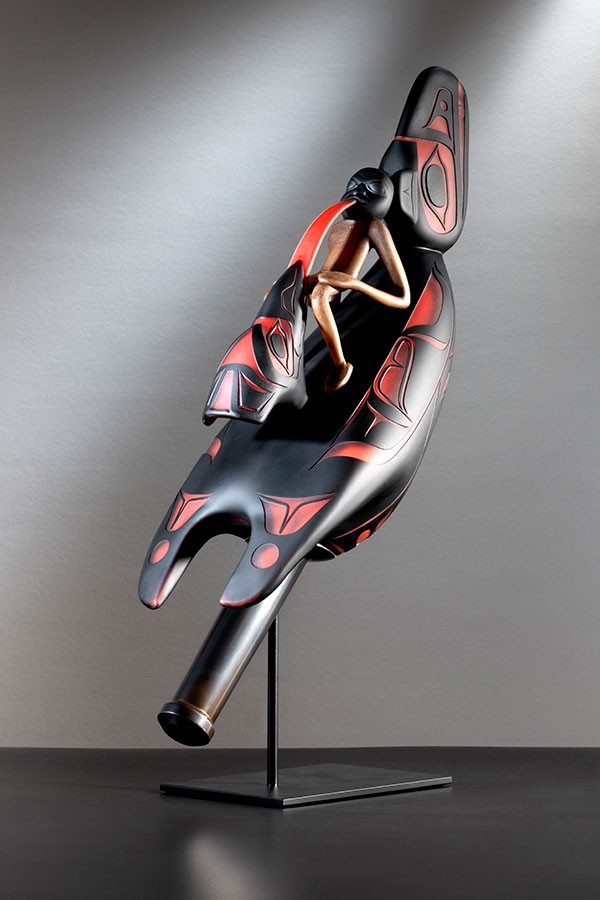
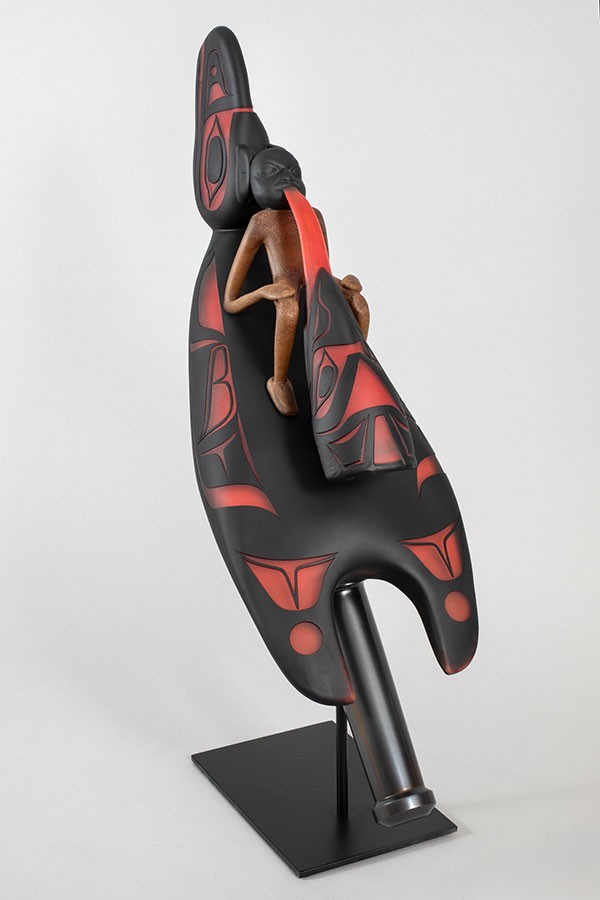
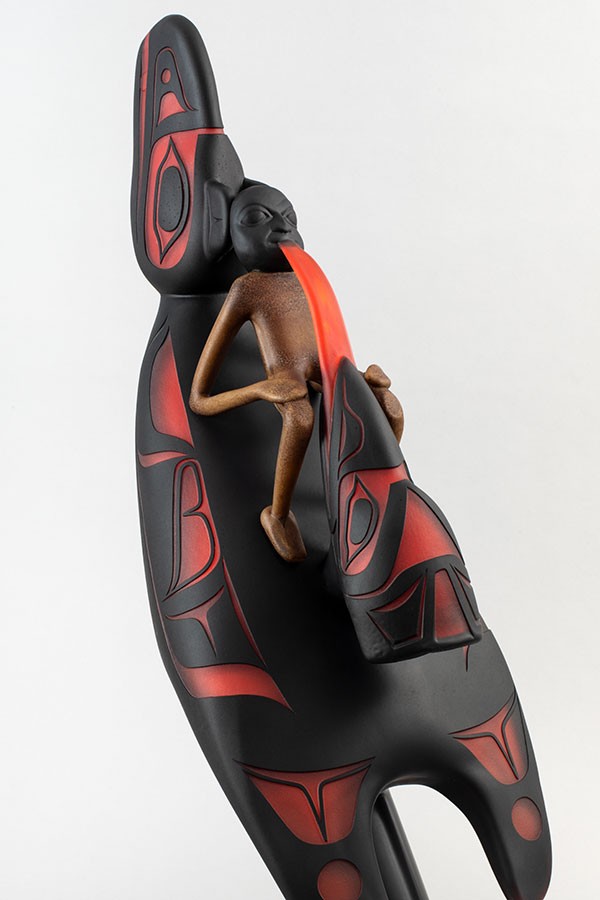

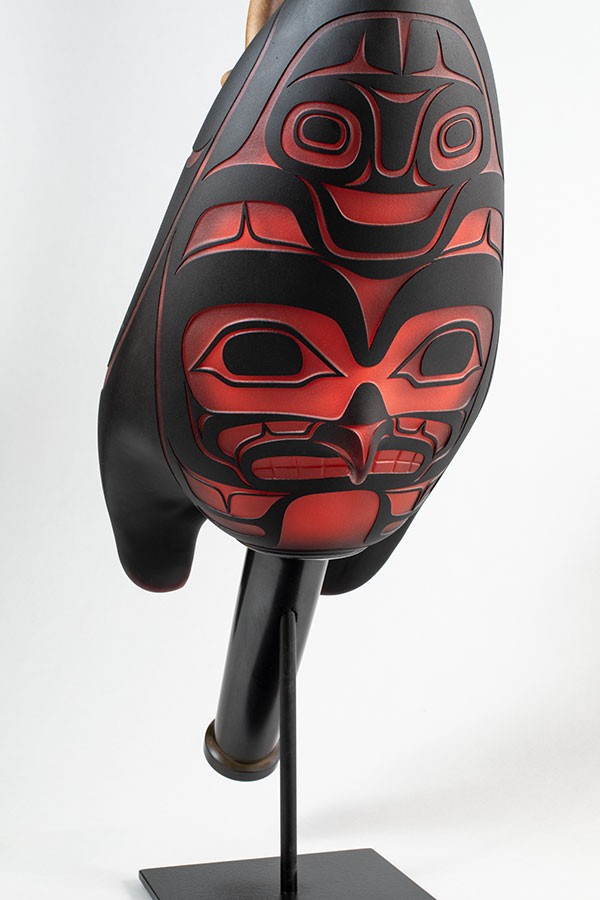
This time they flew, which was a huge relief to Raven, whose feet were aching from all that walking around through the underbrush. Eagle flew low enough and slow enough that they could fly together.
“Tell me,” Raven said to Eagle as they flew. “Are you the Ghost of Christmas Past, Present, or Future?”
“Ha, ha,” laughed Eagle, which really did sound like a chicken’s crow. “I am no more ghost than you, Brother!”
“But you are leading me through a dioramic narrative that suggests some forethought,” Raven said. “If you are not behind it, could it be the Kushtaka pulling the strings of your marionette story?”
Eagle chicken-chuckled.
“It could be,” he said. “It could equally be so that I am but a projection of your subconscious, and that everything I’m showing you, you have already seen. Everything I’m telling you, you already know.”
Raven shook his head in disappointment.
“What?” Eagle asked with a grin.
“Words cannot express the depths of my hunger,” Raven said. “Can our next stop be a coffee shop?”
Eagle smiled and led the way to another clearing in the woods. They landed on a treetop and looked down. In the center of the clearing were two figures. One, a man in shaman garb. The other, a bear. They watched as the two figures sat opposite each other, completely still. Completely silent.
Hours passed and the figures didn’t move. Days. Weeks.
“How long shall we watch this show of nothing happening?” asked Raven.
“Until it is finished,” Eagle said.
So they watched, and they watched.
“What are they doing, if anything at all?” asked Raven.
“The one on the right,” replied Eagle, “is a shaman. You can tell by his skirt of cedar bark and his crown of claws and his long, matted hair.”
“That much I see,” said Raven. “And the other is a bear. But what are they doing?”
They watched as, miraculously, something happened. The bear fell over on its side, dead.
“Dead?” Raven exclaimed.
“Dead,” Eagle confirmed.
The shaman rose then, and with his sharp shaman knife, he removed the bear’s tongue, which he wrapped carefully and stuffed into his smock.
“Some insightful Peter Coyote voiceover might be helpful at this point,” said Raven.
“Indeed,” agreed Eagle. “There is spirit in the tongue because it is how we communicate. A shaman knows that there is power in understanding nature, so he isolates himself, watches, observes. He learns from the animals as he communicates with them. He watches them and sees what they eat; he learns about medicines.”
They watched as the shaman stood solemnly over the tongueless bear.
“But he killed it,” Raven said.
“No, Raven, he did not kill that bear,” Eagle corrected. “That bear gave up his life so that shaman could have his tongue and therefore his spirit and all that it knows. That bear gave that shaman his life; there was no killing involved. Do you see?”
Raven pondered.
“Those zombie humans,” he said. “They had no tongues.”
“That’s right,” said Eagle. “But they didn’t give their tongues willingly, like that bear. Their tongues had been stolen from them.”
“By the kushtaka,” completed Raven.
“When your tongue is stolen,” said Eagle, “your spirit is stolen, too.”
Raven scratched his ear.
“Oh, dear,” he said.
“Yes,” Eagle agreed. “We’ve moved on to the “oh, dear” part of the story. Come. We have miles to go before we sleep.”