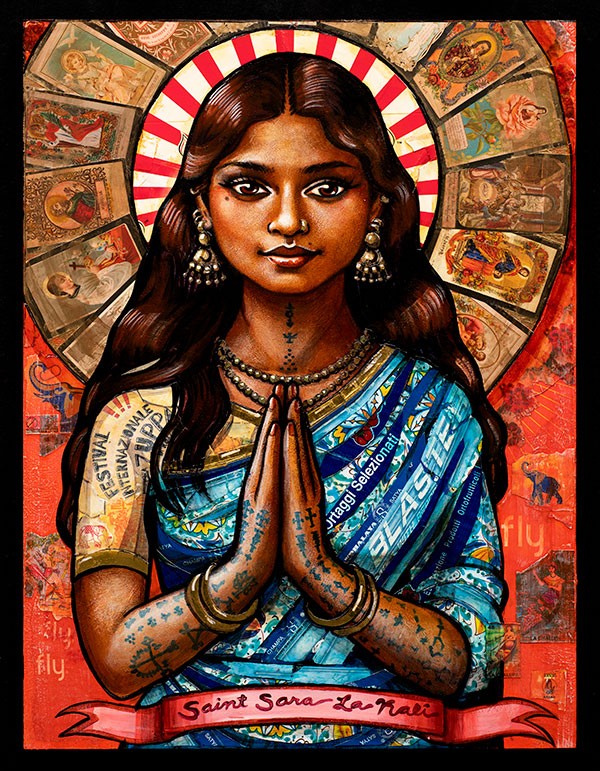
Enigmatic and unofficial, Saint Sara is many things to millions of people. To Christian theologians, she is “Black Sarah,” an Egyptian handmaiden to Mary Magdalene and other Christians fleeing to France after Jesus’s death. Fans of Dan Brown’s Da Vinci Code believe she was the secret daughter of Jesus, hidden from the patriarchy for her safety. For religious historians, this “Black Madonna” is a modern manifestation of the Hindu goddess Kali, a fierce warrior of creation and destruction. Yet to the Roma who make pilgrimages to see her, she is Sara-la-Kali. Since leaving their war-torn home in India in the 11th century, the Roma were unwelcome migrants wherever they went. Over the next thousand years of violent persecution, their patron Saint Sara has provided hope and identity to the more than 12 million members of the Roma diaspora across the globe.
Every year in late May, Sara-la-Kali also gives the displaced Roma a fixed point on the map. More than 10 thousand Roma typically travel to Saintes-Maries-de-la-Mer, a small village surrounded by flamingo-filled marshes and pink salt flats in the Camargue region of France. Here, where it’s believed Sara came to shore with Christian refugees, her weeklong celebration culminates with a procession of a wooden statue of the saint into the Mediterranean. “Sara is a blending of different traditions–Kali and the Black Madonnas,” says Malgorzata Oleszkiewicz-Peralba, a professor with the Department of Modern Languages and Literatures at the University of Texas at San Antonio and author of The Black Madonna in Latin America and Europe. “Everybody is finding in her what they need.” (Courtesy Rebecca Toy, National Geographic)
My homage to the extraordinary, mystical, Saint Sarah La Kali speaks to both her ancient ancestral roots of Northwestern India; & to the European Catholic dimension of her being. Her blue & gold traditional Indian sari is comprised of Sicilian produce boxes; Mediterranean soap packaging; Nag Champa incense boxes; fireworks packaging; Eastern medicinal empty packets with a sword wielding Garuda; a Thai takeout box with an elephant; an Italian Zuppa festival sticker; a ‘queen conch’ page from a child’s marine biology booklet. In the background, Vatican collectable Saint stickers comprise a halo, along with an empty cathedral-style candle box. I’ve also layered Mexican loteria cards with Elephant rolling papers, Hindi comic book pages, & a Turkish airline ticket.