Born in London to an American father & Jamaican mother, Pamela Colman Smith spent her childhood in New York & then Jamaica- a place which later inspired much of her creative work. Smith returned to New York in 1893, enrolling in Pratt Institute for two years, then returning to London following the death of her mother. She illustrated her friend William Butler Yeats’ volume of verses in 1898, & published her own writing, Annancy Stories, a collection of Jamaican folktales. By 1901, she hosted a weekly salon at her London studio, & founded The Green Sheaf. The Annancy Stories particularly won Smith admirers & notoriety. The work played with gender conventions, granting the women characters in these stories agency, & sometimes making the gender of the characters ambiguous. Smith was familiarly known as Pixie, a nickname which captured something of her impish spirit. She had an exotic, flamboyant, & utterly original style which, along with her ethnicity & sexual orientation, sparked speculation & curiosity. In 1907, Smith had her first exhibition at Alfred Steiglitz’ Gallery 291, featuring 72 watercolor paintings. This first exhibition was a commercial hit and Smith would have two more shows at the gallery in the following few years. Many of her unsold paintings and drawings remained in the collection of Stieglitz & Georgia O’Keeffe.
Smith’s spiritual beliefs were oriented toward the esoteric and arcane. She with the Hermetic Order of the Golden Dawn, a secret society that explored the occult & metaphysics. Whitney Museum curator Barbara Haskell notes that these influences were symptomatic of the time. “Smith represents a strain of artists in early American Modernism who were disaffected with materialism and rationalism, but who were also unsatisfied with organized religion and so turned toward more occult pursuits,” she explained. “Theosophy was so influential at the turn of the century and the Hermetic Order of the Golden Dawn was similar—a secret society that looked at ancient texts, the kabbalah, and tarot cards. This was predominant among women and I think of Agnes Pelton as a parallel.” Smith was eventually approached by A.E. Waite, a scholar of the Hermetic Order, who had ambitions to create a new version of the 78-card tarot deck, and who commissioned Smith to create the illustrations. Smith’s most lasting artistic contribution to the world was the Rider-Waite tarot deck. Released in 1909, the deck is now regarded as the standard set, with more than 100 million copies in circulation. Smith’s imagery has become synonymous with tarot itself. Smith, who struggled financially throughout her life, would receive no copyright or credit for her contribution, & was paid only a nominal commission. Following the publication of the deck, Smith illustrated Bram Stoker’s final book. The last years of her life were spent devoted to causeslike women’s suffrage & the Red Cross. She died obscure & penniless at 73; however, the respect for, & honoring of her legacy has begun to expand- with the Whitney Museum of American Art recently highlighting her contributions to the development of Modernism.
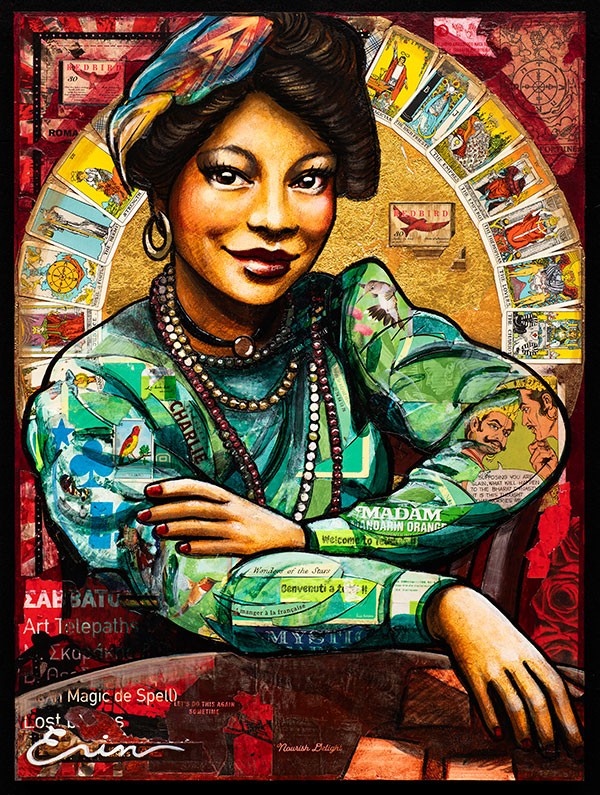
In my homage to Pamela, I’ve layered in an actual tarot deck- given to me by my neighbor Carol; a circus poster from Rome; a hummingbird playing card; a redbird matchbox; a Madam mandarin oranges wrapper; a punk rock poster from Athens Greece with DJ Magic de Spell; a Mystic, Conneticut brochure; a Parisian bar coaster; a page from a Hindu comic book from India; and more…