Marlene Dumas (b. 1953) is regarded as one of the most influential painters working today. Her paintings and drawings, often devoted to depictions of the human form, are typically culled from the artist’s vast archive of images, including art historical materials, mass media sources, and personal snapshots of friends and family. Gestural, fluid, and frequently spectral, Dumas’s works reframe and re-contextualize her subjects, exploring the boundaries between public and private selves.
Born in Cape Town, South Africa, Dumas moved to Amsterdam in 1976, where she has lived and worked since. (David Zwirner)
In exploring portraiture for over 40 years, Marlene Dumas has engaged with a wide variety of subjects: portraits of the dead, portraits of the living, standing nudes, groups, coupled figures, newborns and infants, crying women, and pregnant women. Focused on the human figure, her work explores themes—of race and gender, sensuality and violence, personal realities and public identities—that are constantly in flux. Her relationship to her subjects is informed by her own identity, which embodies cultural divisions: Dumas was born during the South African apartheid and immigrated to the Netherlands to study, where she continues to live and work. Dumas’s sense of “I am always ‘not from here’”builds on her own experience of evolving within ever shifting cultural contexts. Dumas’s notebooks of images, arranged and rearranged by visual sympathy or typology, reflect years of research. Journalistic photographs, newsreels, Polaroids of friends and family members, stills from films, and art-historical antecedents make up a repository of visual knowledge. Dumas’s choice to paint from photographs is political, an act of both bearing witness to contemporary life and making contact through the reworking of mediated images. Dumas wants her imagery to be “grounded in reality.” For Dumas, “painting has to show its method, how it becomes what it is; [it should] move back and forth from the ‘illusion’ to the ‘gesture.’” A Dumas painting is an orchestration of sensations, confronting the viewer both with boldness and tenderness: matte and reflective surfaces, wet and dry contours, neutral and poignant tones all attend to the volumetric nature of the body. Transmitting bodily sensations is a tactile matter, articulated by following one’s hand and intuition. Dumas often establishes the contoured edge of her figures by lifting the sheet of paper and using gravity to guide the rapid flow of liquid pigment. This process is important to creating the skin-like transparent textures in her works. For Dumas, transparency becomes a metaphor for covering and exposing layers of identity. “I do treat my faces with a certain equality,” she has acknowledged. Dumas’s practice is a visual account of her times through the representation of bodies and souls as they navigate through life, politics, and art. “Painting is about the trace of the human touch,” she has said. For Dumas, touch is a vehicle, a medium in itself, to understand, feel, and create within the fluidity of all relationships. It is a trace passing through the experience of time and space. Rendering images of extreme vulnerability, Dumas forces us to face an inescapable existential question: What does it mean to live—and die—in our own bodies? (MoMa)
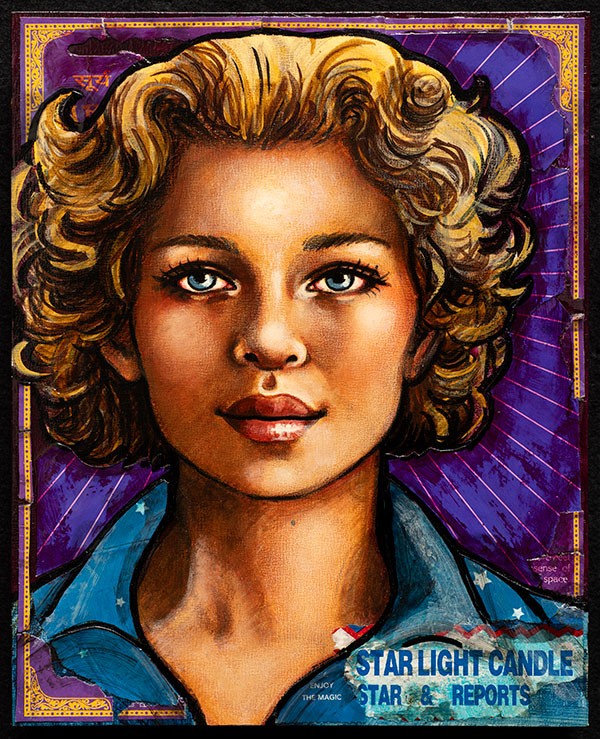
I have long been blown away by the portraiture of Marlene Dumas. Deceptively simple and spare, it packs a punch that is unforgettable. I wanted to celebrate her in that same spirit: with minimal trash (Indian incense packaging; sparkling water ephemera; a candy wrapper); in her palette- of vivid yellows, deep violet, and sky blue; and with a composition she frequently utilizes: head on and looking the viewer straight in the eyes.